
Are Reflective Curb Numbers Worth It? The Science of Glass Beads
Posted on November 1, 2025
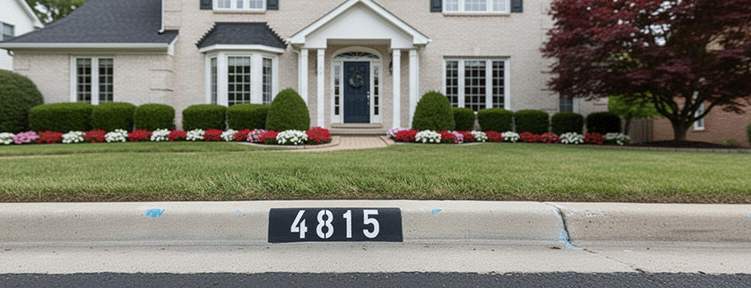
When hiring a professional for curb address painting, you will almost inevitably be asked the upsell question: "Do you want to add reflective glass beads for better night visibility?"
For many homeowners, this sounds like a great safety feature. For others, it sounds like a gimmick that will wash away in the first rainstorm. So, what is the truth? Are reflective numbers actually worth the extra money?
The honest answer, based on the physics of adhesion, is: It depends entirely on the binder (glue) used.
The "Rip-Off": Why Standard Spray Paint Fails
To understand why many homeowners feel ripped off by reflective numbers, you have to understand Film Thickness.
Reflective glass beads used on curbs are typically Type 1 highway gradation. These are small glass spheres. For a glass sphere to remain permanently attached to a surface, it must be embedded 50% to 60% of its diameter into the paint. Think of it like a diamond set in a ring—if the prongs don't come up high enough, the diamond falls out.
The Physics Problem:
- Glass Bead Size: ~10 to 20 mils diameter.
- Standard Spray Paint Thickness: ~1 to 2 mils (when wet).
Mathematically, standard spray paint is simply too thin. When a painter sprays a curb and throws beads on it, the beads don't sink in; they sit on top like marbles on a kitchen counter. They might stick for a few weeks, but UV rays and rain will quickly break that weak bond.
In this scenario, paying extra for reflective beads is not worth it.
The "Worth It" Solution: High-Build Binders
However, when applied correctly, reflective numbers are a critical safety tool that helps ambulances, fire trucks, and delivery drivers locate your home in the dark. For the beads to last 5+ years, the painter must use a High-Build Binder capable of achieving that critical 50% embedment.
If your curb painter uses one of the following three materials, the reflectivity is absolutely worth the investment:
1. Rubberized Clear Sealants / Adhesives
One of the most effective modern methods involves using a heavy-duty Rubberized Sealant or specialized adhesive spray. Unlike standard paint, rubberized sealants are designed to be applied in thick, viscous layers.
Because these sealants remain flexible even after curing, they expand and contract with the concrete curb during temperature changes. When glass beads are applied to a wet rubberized sealant, they sink deep into the coating. The rubber cures around the bead, creating a waterproof, impact-resistant grip that holds the bead in place for years.
2. High-Solids Traffic Paint
This is the industry standard used on highways and airport runways. Traffic paint is chemically formulated with a high "solids content," meaning it doesn't shrink much when it dries. It can be applied at 15+ mils wet, allowing the beads to properly embed.
3. Epoxy or Resin Coatings
For the ultimate durability, some high-end curb painters use clear epoxies. These create a hard, plastic-like shell over the curb. While more expensive, epoxy holds glass beads with a grip strength higher than the concrete itself.
The Verdict
Don't be afraid to ask your professional curb painter about their process. A simple question can save you money:
"Do you use a high-build binder like rubberized sealant or traffic paint for the beads, or do you just apply them to the spray paint?"
If they use a dedicated adhesive sealant or industrial coating, the reflective upgrade is 100% worth it. It transforms your address into a passive safety device that works 24/7, guiding help to your door when it matters most.